 Árbol InteriorThe project
Raphael’s School of Athens: an image of thought
In this reading
Raphael and his time
Raphael Sanzio was born in 1483 in Urbino, capital of the duchy of the same name, in present-day Italy. At the time, Italy was not yet a unified country. He died in Rome in 1520, at the age of thirty-seven. He was one of the great artists of the High Renaissance, alongside Leonardo da Vinci and Michelangelo. His father, Giovanni Santi, was a painter, and Urbino’s artistic atmosphere shaped his early years.
In 1504 he moved to Florence, where he studied the works of other masters. From Leonardo he learned new ways of grouping figures and making them appear natural; from Michelangelo, the power of the body and of movement. In 1508 Pope Julius II summoned him to Rome. There he developed an extensive practice that included frescoes, portraits, and tapestry designs. National Gallery of Art
Julius II was pope from 1503 to 1513 and a patron of the Renaissance. He commissioned Raphael to decorate his rooms in the Vatican and Michelangelo to paint the ceiling of the Sistine Chapel. Vatican Museums: Raphael’s Rooms, Sistine Chapel
His ability to learn from others is especially interesting. Raphael developed a language of his own through travel, encounters, and commissions. In his compositions, clarity seems to emerge effortlessly, although careful organizational work lies behind it. National Gallery, London
This search for balance helps us understand The School of Athens. The painting brings together many figures and numerous actions, yet allows the eye to find a path among them.
The School of Athens in the Vatican
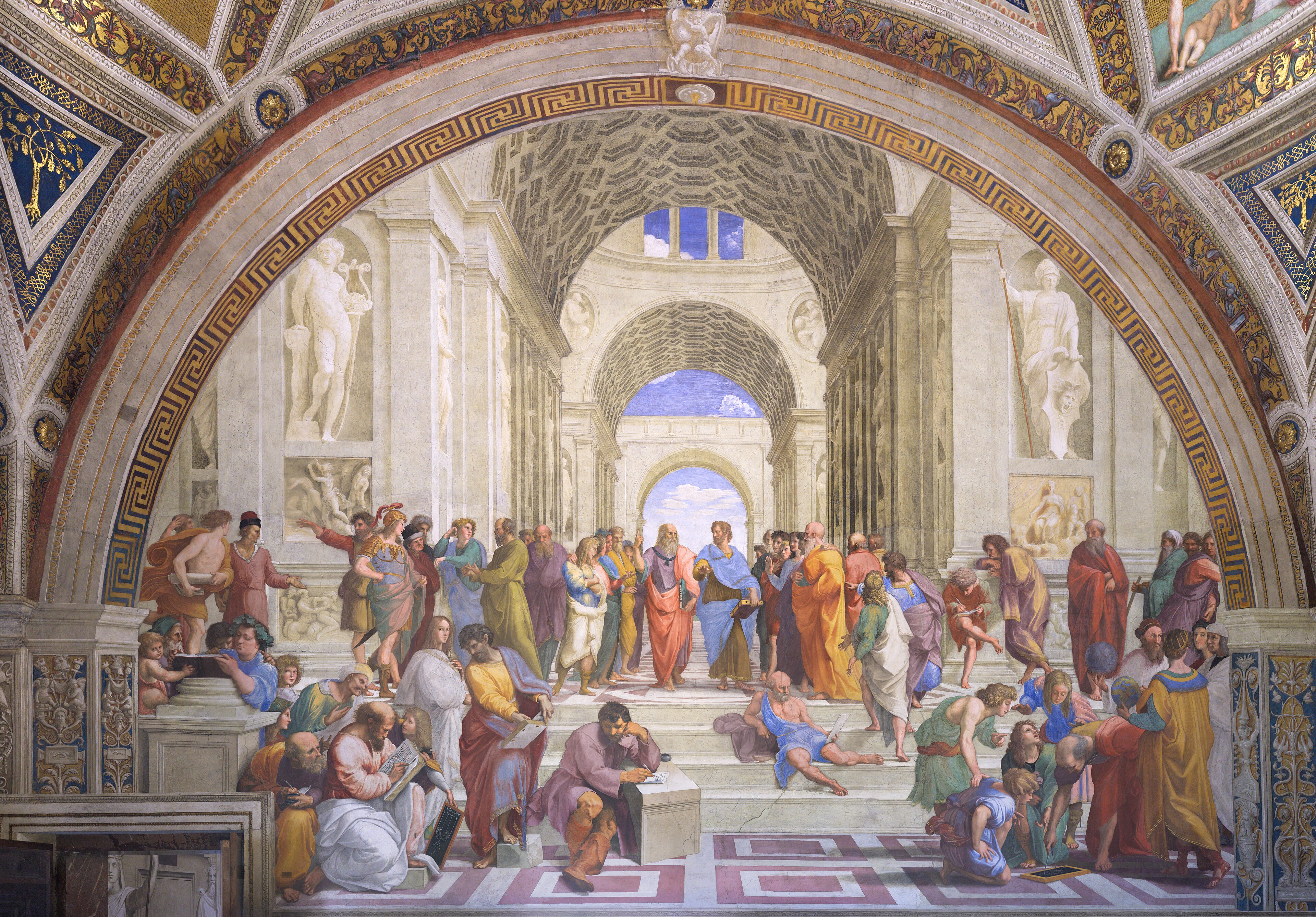
The School of Athens was painted between 1509 and 1511 and is preserved in the Stanza della Segnatura, in the Vatican’s Apostolic Palace.
According to the Vatican Museums, Julius II originally used this room as a library and private study. Its current name comes from the tribunal that later met there. The wall paintings articulate different fields of knowledge: philosophy, theology, poetry, and justice. The School of Athens represents philosophy, while the Disputation of the Holy Sacrament corresponds to theology. Vatican Museums: the room
This context changes the way we look at the work. The assembly of ancient thinkers is part of a program created for a pope, in a room devoted to study. The revival of the classical world takes place within the Christian culture of the Renaissance.
We can read the ensemble as a search for connections among different forms of knowledge. This reading allows us to appreciate its aspirations to harmony without assuming that every difference between reason and faith had been resolved.
Painting on a wall
The work is painted in fresco. This technique involves applying pigments dispersed in water to a layer of lime plaster that is still wet. The painter must organize the work according to the areas that can be completed before they dry. Each of these areas is called a giornata, an Italian word related to a day’s work.
Preparation requires drawings and precise planning. A cartoon is a full-scale drawing used to transfer the design to the surface. This vocabulary reminds us that painting emerges from material decisions: preparing the wall, establishing outlines, arranging the figures, and coordinating the execution. Columbia University: technique
As we contemplate the whole, those stages disappear from our attention. We see a continuous scene. Part of Raphael’s achievement lies in turning complex, fragmented work into a visual experience that seems fluid.
An architecture for thought
The first thing that organizes the image is its grand architecture. The arches and vaults create depth; the steps arrange the figures on different levels. The building’s lines guide the eye toward Plato and Aristotle, positioned at the center.
The Vatican Museums connect this space with Bramante’s design for the rebuilding of St. Peter’s. It is an architecture imagined for the painting, inspired by the monumental aspirations of the Renaissance. Vatican Museums: the work
The composition combines an overall order with numerous variations. There are groups in conversation, figures bending over a book, bodies gathered around a demonstration, and individuals who remain apart. The steps offer places to pause while also opening a path toward the background.
To appreciate the painting, it helps to alternate between two viewing distances. First, we can look at the whole: its balance, depth, and arrangement of bodies. Then we can move closer to a hand, a face, or a posture. The scene becomes more interesting when we discover that its harmony contains very different movements and rhythms.
In a formal reading, the architecture can be understood as the shared space that allows this diversity to coexist. This is an interpretation of what we see, not a written explanation preserved from Raphael.
Raphael left no complete list of who is who, so some identifications are more certain than others. Books, gestures, and actions guide us, along with later accounts and interpretations. Let us begin with the two figures at the center.
Plato and Aristotle: two gestures at the center
Plato and Aristotle are the most firmly identified figures in the work. The books help us recognize them: Plato carries the Timaeus; Aristotle, the Ethics. The former raises a finger, while the latter extends his hand forward, palm down. Vatican Museums: the work

Plato’s upward gesture is often associated with an intelligible order, accessible through thought. Aristotle’s is usually interpreted as attention to concrete reality and experience. This contrast offers a simple point of entry into the scene. University of Oxford: educational reading
However, both philosophers deserve a reading broader than that formula. The Timaeus also studies the physical world, while Aristotle attaches importance to contemplation. Their gestures can guide the reader without becoming a complete summary of their philosophies.
In the painting, the two walk together and occupy equivalent positions. Their differences do not exclude them from the shared space. We can see here an image of intellectual dialogue: thinking with someone else does not require thinking exactly the same thing.
It has also been suggested that Raphael gave Plato the features of Leonardo da Vinci. This is a traditional attribution, repeated in various readings of the work. It should be presented as such and distinguished from the identification of the figure as Plato, which is supported by his book. Antigone: identifications and interpretations
The conversation expands
Around the central pair, thought takes other forms. In the left foreground, the figure traditionally identified as Pythagoras concentrates on a book. On the right, the teacher usually called Euclid gives a geometric demonstration to his pupils. On the steps appears the figure traditionally recognized as Diogenes. Vatican Museums: the work
These identifications help us explore the painting, but they do not all carry the same degree of certainty. Sometimes a figure’s activity is clearer than their name. We can recognize that someone is teaching geometry without settling definitively whom they represent.
This caution does not prevent us from enjoying the scene. On the contrary, it allows us to observe before labeling. Who is listening? Who seems to be explaining? Which groups direct their attention toward the same point? Who remains alone? The answers show how Raphael builds relationships through bodies and gazes.
The work brings together figures from different periods in an imaginary encounter. It can therefore be understood as an ideal representation of intellectual life rather than a record of a historical gathering.
Michelangelo and the solitary thinker
In the foreground, a man leaning on a block seems absorbed in thought. He is usually identified as Heraclitus, and his features are associated with Michelangelo. The Vatican Museums include this association; other readings emphasize its traditional character. Vatican Museums, Antigone
His presence introduces a pause within the collective movement. While others exchange ideas or follow an explanation, he occupies a space of individual concentration. We can appreciate this contrast without attributing a precise emotion to him or turning his posture into a biography.
The association with Michelangelo adds another possible reading: the ancient world enters into dialogue with Renaissance artists. The painting brings different periods closer together and allows us to imagine contemporary artists as participants in a history of knowledge.
Raphael within his own work
At the far right appears a young man in a dark cap who looks toward us. He is recognized as a self-portrait of Raphael. This identification has an early witness: Vasari describes him this way in the 1568 edition of his Lives. Columbia University: passage from Vasari
This detail changes our relationship with the scene. Among so many gazes focused on books, conversation partners, and demonstrations, one turns toward the viewer.
We can interpret this inclusion as an affirmation of art’s intellectual dimension. The painter, too, observes, studies, organizes, and produces knowledge. Raphael appears within the community he has imagined, although no statement of his survives that definitively explains this choice.
Appreciation and critical reading
One of the most remarkable qualities of The School of Athens is its ability to organize complexity. The composition offers a recognizable center and leaves room for multiple encounters. Its clarity invites us to look; its details make our gaze return.
It also deserves a critical reading. The community depicted reflects a Renaissance cultural selection and a specific papal commission. It cannot be taken as a complete image of the history of philosophy. Asking who occupies the center, who remains at the margins, and which traditions are absent broadens our relationship with it.
The uncertainty of some identifications also has value. It reminds us that looking at a work includes recognizing the limits of what we know. We can distinguish between a visible detail, a traditional attribution, and a personal interpretation without losing the emotion of the encounter.
Returning to the center, we find Plato and Aristotle once again. Their gestures differ, but the path they walk is shared. From our perspective, this coexistence allows us to think of philosophy as a continuing conversation: a search in which listening, debating, and revising what we believe we know are part of the same movement.